

Gerry Tietje
When I was a young boy growing up in Wisconsin, I used to mix up syllables in words, like saying “aminals” instead of animals, or “flutterbys” instead of butterflies. As I grew older, I sometimes did it on purpose, waiting for a response from the listener. Regardless of what you call them, butterflies are miracles of nature. Starting as a tiny egg on a host plant, emerging as a hungry caterpillar, encasing itself in a hard-shelled pupa, and emerging as a winged adult, butterflies are truly amazing!
Butterflies are classified as insects, in the order Lepidoptera, which means “scaled wings.” Adult butterflies have two forewings and two hindwings; a head, thorax and abdomen; three pairs of jointed legs; and clubbed antennae. Adult females lay eggs on specific food plants so caterpillars have a chance to survive, although many end up being food for birds, including young chicks. Adults suck nectar from favorite flowers, and most have short lifespans. There are hundreds of butterfly species in North America; the ones described below are commonly seen at SaddleBrooke Ranch.
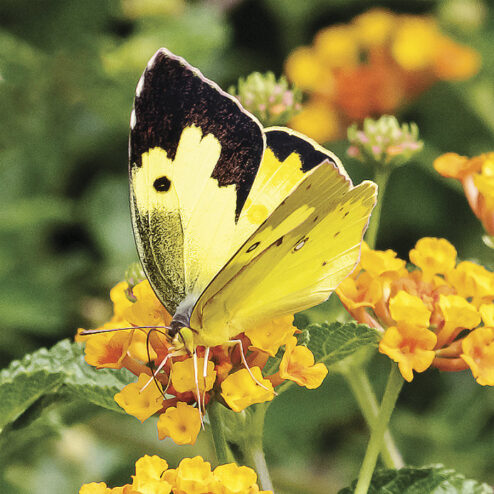
Sulphur butterflies come in a range of colors and sizes. Most are yellow with black patterns on the upper sides of their wings, including an outline of a dog’s face and eye dot on Southern Dogface butterflies. Others have orange upper sides, like the Sleepy Orange and Tailed Orange butterflies. Sulphurs perch with their wings folded tightly above their backs so these intricate patterns are usually visible only when they are flying. Larger sulphurs have a wingspan of two inches while the smallest sulphur, the Dainty Sulphur, has a wingspan of less than an inch.
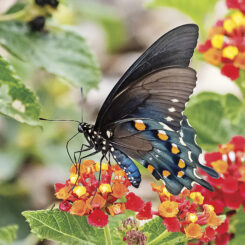
Swallowtails are the largest species of butterflies in North America, and the Pipevine Swallowtail is most commonly seen at the Ranch. Swallowtails have elongated extensions on their hindwings, or tails. Pipevine Swallowtails are mostly black, but males have a lovely blue iridescence on the upper side of their hindwings, and a row of bright orange dots in a field of iridescent blue on the underside of their hindwings. Pipevine Swallowtails are named for the food plant on which females lay their eggs, the pipevine. This noxious plant, on which caterpillars feed, is beneficial to adults as it renders them distasteful to predators.
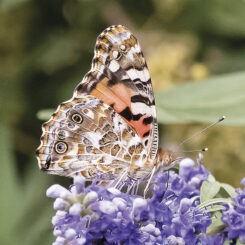
Painted Ladies are probably the most familiar butterfly species we see. They winter in Mexico and migrate northward in droves in spring. When we first moved to SaddleBrooke Ranch a few years ago, the chaste tree in our front yard was blooming and as many as 50 Painted Ladies at a time were flitting about the blossoms. Both the upper and lower sides of the wings of Painted Ladies are arrayed in black, white, and orange patterns. Hindwings have a row of four eyespots on both sides. They are among our most colorful butterflies.
As you see butterflies flutter by this summer, enjoy these unique insects. They are more abundant in some years and I’m hoping this is one of them.