

Ben Eisenstein
Autumn is one of the best times to explore the night sky, and you don’t need a fancy telescope to enjoy it—a simple pair of binoculars will do. Here are three of my favorite fall targets, all easy to spot.
These objects are best seen under dark skies, so a little planning helps. Here at SaddleBrooke Ranch, our HOA lighting rules give us wonderfully dark-sky nights, especially after 10 p.m., when most outdoor lights turn off. The sky is darkest during the two weeks surrounding a new moon; October’s new moon falls on the 11th. Before you start, give your eyes 15 to 20 minutes to adjust to the darkness. If you need your phone, switch it to red-light mode so you don’t ruin your night vision.
To find these objects, use a star chart or try an astronomy app available on your phone. I recommend Sky Safari Basic for beginners—it’s inexpensive and lets you point your phone at the sky to identify constellations, planets, and deep-sky objects. Plenty of other apps work just as well, so feel free to browse your app store.
The Pleiades
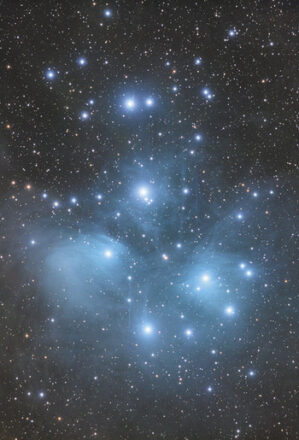
The Pleiades, also known as the Seven Sisters, is one of the easiest objects to spot in the fall sky. Its six or seven brightest stars are visible to the naked eye. In Greek mythology, the sisters were nymphs and companions of Artemis, the goddess of the hunt. To find the Pleiades, locate Orion’s Belt, then draw an imaginary line through its three stars toward the bright orange star Aldebaran in Taurus, and continue that line to spot the small, blue-white cluster. The cluster rises in the east by mid-to-late evening. It’s an open cluster, meaning all its stars formed from the same cloud of gas—and there are actually about 1,000 stars in it. The light you see left those stars 444 years ago.
The Andromeda Galaxy
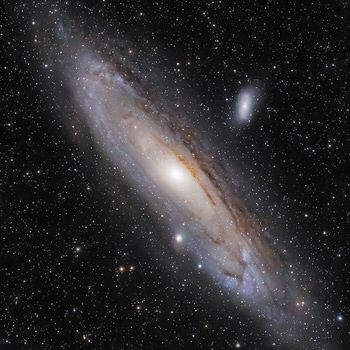
Next, look for the Andromeda Galaxy in the constellation Andromeda. In Greek myth, Princess Andromeda was the daughter of Cassiopeia and was chained to a rock as an offering to the sea monster Cetus. This galaxy is our nearest major galactic neighbor. Even though it’s 2.5 million light-years away, it’s faintly visible to the naked eye under dark skies. It contains roughly a trillion stars. To find it, locate Cassiopeia’s “W” shape, then find the stars Caph, Schedar, and Navi—these three form a triangle that points toward the galaxy, with Schedar as the brightest star.
The Double Cluster in Perseus
Finally, search for the Double Cluster in Perseus. According to myth, Perseus beheaded Medusa and used her head to turn Cetus to stone, saving Andromeda. The gods placed him in the sky, and the two clusters mark the jeweled handle of his sword. Visible to the naked eye, the clusters lie between Cassiopeia and Perseus, about 7,500 light-years away in the Perseus Arm of our Milky Way galaxy.
Grab your binoculars, find a dark spot, and enjoy the show!