

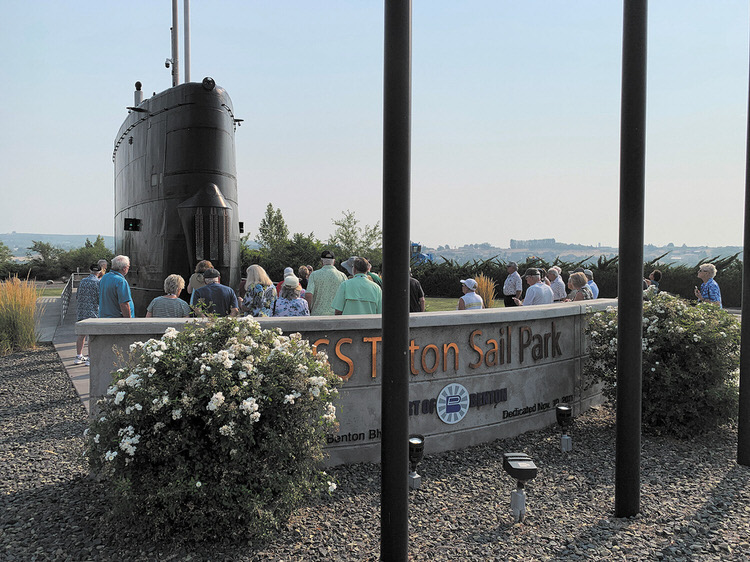
The USS Triton was the first vessel to complete a submerged circumnavigation of the Earth fueled by nuclear power (1960). This was an impressive feat marked a significant milestone in the history of naval exploration and the use of nuclear power for non-combat purposes. Decommissioned in 1968, the Triton was the first nuclear submarine to be taken out of service by the U.S. Navy. Later, in a project lasting from 2007 to 2009, the Triton was dismantled and recycled in Bremerton, Wash. However, the Port of Benton preserved the iconic “sail” of the submarine—the conning tower, outfitted with its original instruments—and installed it at this park in 2011, creating a lasting tribute to the vessel’s historical impact. (Photo taken by Linda Harvey in Richland, near Hanford, Wash.)
Linda Harvey
As a surprise to some, we learned that the story behind the designing, testing, and building of top-secret atomic weapons that helped bring the end of World War II is being preserved as a national historical park. At our recent meeting and via Zoom, National Park Service Ranger Nicholas Murray carefully explained what is known as the Manhattan Project National Historical Park.
Ranger Murray explained that the Manhattan Project quickly grew from its New York Manhattan District headquarters to more than 30 top-secret sites around the country. Smaller sites supported work at the project’s three primary centers of operations: Hanford, Wash.; Los Alamos, N.M.; and Oak Ridge, Tenn. Most of the research, innovation, production, and weapons fabrication occurred at these three locations.
Established in 2015, the Manhattan Project National Historical Park preserves and interprets the nationally significant sites, stories, and legacies associated with the race, primarily against Germany, to develop atomic weapons. In August of 1945, the U.S. dropped atomic bombs on Hiroshima and Nagasaki, Japan, which profoundly changed future generations to live in a nuclear world.
Shortly after scientists in Germany discovered fission (a nuclear chain reaction created by splitting the atom) in December 1938, Albert Einstein signed a letter that was sent to President Franklin D. Roosevelt warning that an “extremely powerful bomb” might be constructed by Germany. The Advisory Committee on Uranium was formed in 1939. Once the U.S. entered the war after the attack on Pearl Harbor in 1941, the Advisory Committee concluded that an atomic bomb could be designed and built by the U.S., and used in time to influence the outcome of the war. To accomplish this task, the Army Corps of Engineers was directed to form the appropriate team to focus on this top-secret effort which combined military, scientific, and industrial resources that grew to involve hundreds of thousands of workers across the country.
Scientists theorized there were two potential paths to building an atomic bomb. One was to use the uranium 235 isotope; the other would use the newly–discovered element plutonium. Since both paths were expensive and unproven processes, and success was not guaranteed, the decision was made to move forward with both paths to support the project. The uranium 235 isotope bomb was dropped on Hiroshima (Aug. 15, 1945) and the plutonium bomb was dropped on Nagasaki (Aug. 9, 1945).
For more information about this and other national park sites, visit nps.gov.
The club thanks NPS Ranger Nicholas Murray for sharing his time and knowledge with our club.
Next club meetings are: Community Sharing of the Spring trip to the Flagstaff parks (Sept. 8), Guinness World Recorder holder Karen Doerzaph on feat in Grand Canyon (Oct. 13), a review of fall trip to Acadia National Park (Nov. 10).
For more information about the club, email linda_harvey@hotmail.com.