



Jim Hoagland
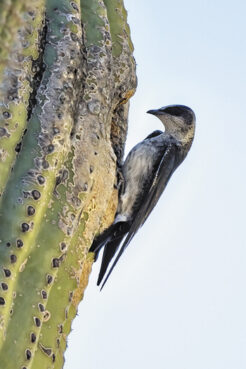
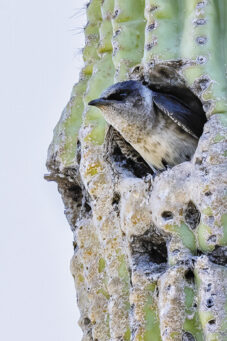
Many from the Midwest and East are familiar with the Purple Martin (Subis) that roosts in Martin Birdhouses or gourds, but did you know our Desert Purple Martin (Hesperia) is a distinctive subspecies that times its nesting to our monsoons and is almost exclusively associated with saguaros or other large columnar cacti?
Several Ranchers attended a presentation in the La Hacienda, presented by Jennie MacFarland, Director of Bird Conservation at Tucson Bird Alliance (TBA), to learn more about our Desert Purple Martins. According to Jennie, our Purple Martins have been extremely understudied, but thanks to a TBA-collaborating partnership with the Purple Martin Conservation Association (PMCA), Jennie has been involved in a study launched in 2020. Knowledge is being accumulated about their nesting, migration, and winter grounds.
You’ll find three Desert Martin subspecies in North America: “Eastern” Purple Martin, “Forest” Purple Martin, and “Desert” Purple Martin, with the “Forest” and “Desert” subspecies occurring in the West.
Our Desert Purple Martins have a very restrictive range here in Southeast Arizona and the Mexican Sonoran Desert. They don’t even return to the desert until May and breed mainly in July and August, where they nest after the monsoon begins and raise their young in the cavities made by woodpeckers and flickers in the saguaros. They typically lay 3-6 eggs, and incubation lasts 15-18 days. The fledglings are fed mainly dragonflies, damselflies, and other flying insects. They usually leave the nest about 20-26 days after birth. Using wireless endoscopy cameras with telescoping poles and tracking equipment attached to the birds, Jennie and her colleagues have obtained previously unknown information about the Desert Purple Martins.
One of the most fascinating pieces of information discovered was where they go in the winter. Much has been known about the Eastern Purple Martins and their migrations, but the Desert Purple Martins’ migration route was a complete mystery. In 2022, small trackers were placed on a couple of Purple Martins, and one bird was recaptured in 2023 with its tracker still attached. That information was gold. It was the very first look at where the Desert Purple Martins migrate in winter. The fact that they went to eastern Brazil was new information. In 2024, they switched to more sophisticated Loteck satellite trackers that provided invaluable real-time data and tracked a male all the way to the Brazilian State of Pernambuco in January.
At the end of her presentation, Jennie invited all to join her for a “Purple Martin Perch Party” scheduled during the week following her presentation. Four Ranchers and several other Mammoth and SaddleBrooke birders joined her to enjoy watching the Purple Martins perch on the wires along River Road near San Manuel and, eventually, at dusk, to watch more than 300 birds gather and make their way to the trees along the San Pedro River to roost for the night.
According to Jennie, this is the largest breeding colony of Desert Purple Martins in Arizona. If you are interested in seeing this phenomenon that will occur through mid-August, contact Jim Hoagland at jahbirding@mindspring.com for details. If you are a golfer here at the Ranch, look for Purple Martins on the wires and around the pond on Hole Number 5.
In addition to Jennie’s work with Purple Martins, she has also headed up various species-specific surveys for Copper-tailed Trogons, formerly known as Elegant Trogons, and Elf Owls. If you would like to learn more about our Desert Purple Martins, track down and view a YouTube presentation she did at the beginning of the year. Search “Tracking Desert Purple Martins with Jennie MacFarland.”