

Gerry Tietje
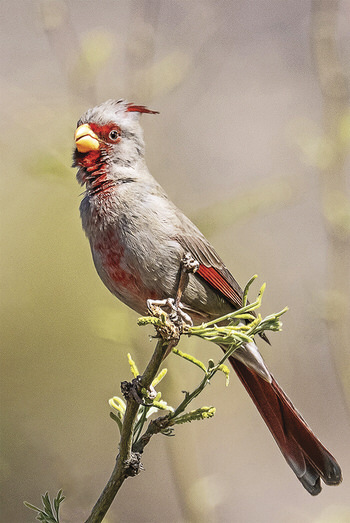
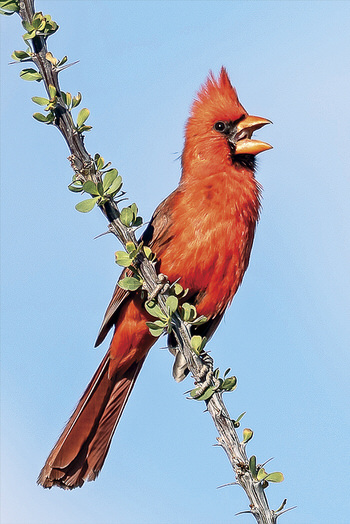
When I moved to SaddleBrooke Ranch (SBR) four years ago and took my first walk on the Nature Trail, I was both surprised and delighted to see a colorful Northern Cardinal perched high in a tree. I was familiar with cardinals from my boyhood in Wisconsin and schooling and work in Indiana, but had seen few since moving to the West coast in 1973. A few weeks later I saw another bird along the Nature Trail. It looked like a female Northern Cardinal, but not exactly. After I got home, I looked at my bird books and identified it as a Pyrrhuloxia (pronounced pir-uh-lox’-ee-uh), a kissin’ cousin of the Northern Cardinal. They are both classified with the same genus, that is, they share common characteristics. How fortunate we are to have these two birds with striking plumage here at the Ranch.
The Northern Cardinal (Cardinalis cardinalis) is perhaps the most recognizable and loved songbird in North America. It was chosen as the official state bird by seven states: Illinois, Indiana, Kentucky, Ohio, North Carolina, and West Virginia; no other bird species can boast this acclaim. Northern Cardinals have crests, long tails and stout, conical reddish-orange bills. Males are red all over except for a black patch on the face and throat. Females are buffy brown with tinges of red on their wings, crest and tail. Both male and female cardinals “sing,” which is unusual since normally only male songbirds sing. The loud, whistling sound they make resembles “chee, chee, chee” followed by “purty, purty, purty.” Northern Cardinals are non-migratory, and their range has steadily increased northward and into the Southwest, where we live. Cardinals eat seeds, grains, fruit, insects, and flower buds and blossoms. Females lay three or four pale bluish eggs in cup-shaped nests, and after the nestlings’ hatch, they fledge in 9 to 13 days. Two broods a year are common.
Pyrrhuloxias (Cardinalis sinuatus), or desert cardinals, share many of the characteristic features of the Northern Cardinal, with a few exceptions. The most distinguishing feature is the yellow bill, which is thick, short, and parrot-like. Males are gray overall with bright splotches of cool red on their crest, face, breast, wings and tail. In flight, their underwings are pink. Females are drab and look like Northern Cardinal females with only tinges or red on the tips of their crests, wings and tails. Pyrrhuloxias like mesquite trees, and their range includes southern Arizona, New Mexico, and Texas within the continental United States. They are also found in Mexico.
Arizona could have chosen either of these kissin’ cousins for its official state bird but chose the Cactus Wren instead. I can’t argue with this selection but think both the Northern Cardinal and Pyrrhuloxia should have been in the running. Next time you walk the Nature Trail keep your eyes open for these two beautiful birds.