

Gerry Tietje
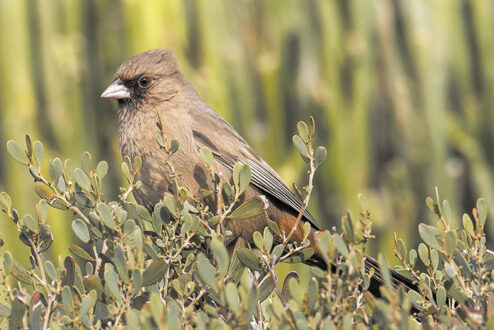
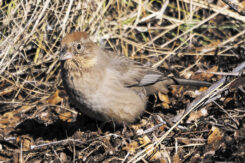
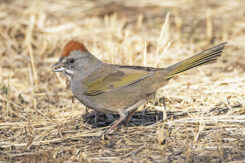
We see three towhee species here at the Ranch: Abert’s, Canyon, and Green-tailed. The first two are year-round residents, and the Green-tailed Towhee is a winter resident.
Towhees are in the family Emberizidae, which also includes sparrows. They have rounded heads, conical bills and long tails; they are the largest songbirds in the sparrow family. Though rather drab in comparison to other songbirds, towhee species do have distinctive colorations, with both sexes looking basically alike. They are readily recognizable by a foraging technique that involves using both feet simultaneously to do a double hop-scratch of leaf litter to uncover food, mostly seeds, on the ground. Their conical bills are used to husk the seeds. In summer, towhees feed mostly on insects. They like dense brush and nest either on the ground or in low bushes. When towhees vocalize, their two-pitched call sounds like “tow-hee.”
The Abert’s Towhee is pinkish-brown overall, with a distinctive black face and bib. Its silvery bill is accentuated by its dark face. The Abert’s Towhee was named for Lt. Colonel James W. Abert, a naturalist and military explorer who first discovered and documented the species in New Mexico in the mid-1800s. They are secretive birds, often found in dense brushy areas near a water source at elevations between 1,000 and 4,900 feet.
Canyon Towhees closely resemble California Towhees, which you’ll find in the tangled chaparral and other hot scrublands of California and Oregon; they’re typically not seen here at the Ranch. At one time, taxonomy experts combined the two species as a single species, but they later split them because their ranges do not overlap. Canyon Towhees’ bodies are monotone gray, but they have a distinctive buffy throat with a black streaked “necklace” and dark central spot on the breast. They have a dull, rufous (reddish-brown) cap and bold buffy eye ring. Their range extends to slightly higher elevations than the range of Abert’s Towhees, up to 6,000 feet.
Green-tailed Towhees are the most colorful of the three but are seen in our area only after fall migration and through the winter. They have olive-green backs and gray breasts, and the edges of their tails and wings are green, hence their name. They also sport chestnut-brown caps and snow-white throats and whiskers. Green-tailed Towhees are the smallest of our three resident towhees, about 7.5 inches long.
When bird watchers see a new bird species it is known as a “lifer,” and they generally remember exactly where they saw it for the first time. I remember seeing my first Abert’s Towhee at the Sonny Bono National Wildlife Refuge near the Salton Sea in California. I first encountered a Green-tailed Towhee on a hike around Convict Lake in the eastern Sierra Nevada of California and saw my first Canyon Towhee during one of SaddleBrooke Ranch (SBR) Birdman Jim Hoagland’s monthly bird walks on the SBR Nature Trail. Since then, I’ve seen all three species on the Nature Trail and in my backyard here in birdy SaddleBrooke Ranch.