

Gerry Tietje
It has been said that everything in the desert either bites, stings, stabs, or sticks, and that certainly includes cacti, which have spines that are hooked, barbed, and sharp. Who hasn’t walked out into the desert without acquiring a prickly sphere on a pant leg or shoe? Cacti (Cactaceae) are succulents that store water in their fleshy stems and have areoles from which spines, hair and beautiful flowers grow. The primary types of cacti we encounter in the Sonoran Desert around us are hedgehog, prickly pear, cholla, barrel, and the saguaro.
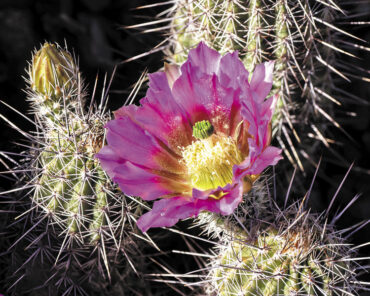
Hedgehog cacti grow in short, cylindrical stems covered with dense spines. They are the first to bloom in spring, as early as late March. Their flowers are generally shades of pink or red, and each flower blooms for 3 to 5 days. Someone thought they looked like a spiny-backed hedgehog animal and named the cacti accordingly. The popular ornamental we see in many SaddleBrooke Ranch yards, the Claret Cup, is a hedgehog.
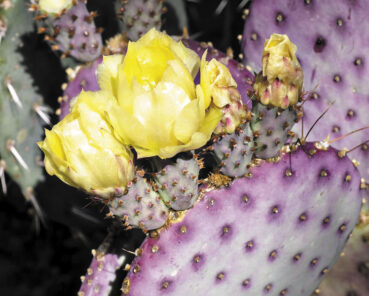
Prickly pear cacti are also early bloomers. They are easily recognized by their flat, inverted teardrop-shaped pads. They spread readily and sometimes cover a large area. They produce relatively large and plentiful flowers in yellows, pinks, and reds. The purple prickly pear is an especially attractive ornamental in spring when it produces bright yellow flowers. The mild-flavored fruit of the prickly pear is used in jellies, syrups, candies, and even margaritas.
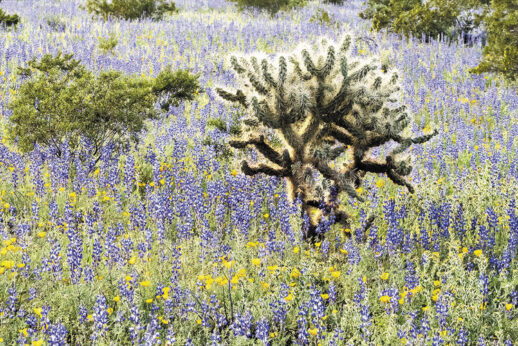
Cholla cacti are the most diverse. Chollas have a tall tree-like structure with sausage-shaped segments that can be long or short, fat or pencil-thin. With names like Teddy Bear, Staghorn, Buckhorn, Cane, Jumping, and Pencil you can imagine how different they must look from each other. Flowers bloom on different species from March through September, but April is normally their peak month for flowering. Different plants of the same species produce flowers of various colors including yellow, pink, red, orange, bronze, and even green. Stem segments of some varieties turn purple in winter, and some retain fruit into the winter. Teddy Bear and Jumping Cholla have the spherical segments that readily break off and end up on clothing worn by desert wanderers.
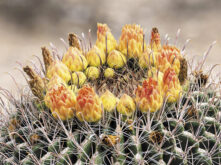
Barrel cacti need monsoon rains to bloom, so they are relatively late bloomers. Most common in our area are the Fishhook Barrels, named for their spines that resemble fishhooks. These barrel-shaped cacti produce a crown of bright red-orange flowers between July and October, depending on when the rains fall. In winter they have a crown of yellow fruit. Fishhook and Compass Barrel cacti tend to lean in a southwesterly direction.
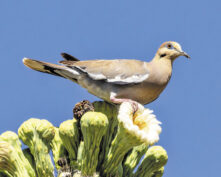
The giant saguaro cacti are the icons of the Sonoran Desert. Large white blossoms with yellow centers appear as early as late April and bloom into early June. Flowers blossom during the evening and are pollinated by nocturnal bats. Although flowers only last a day, hundreds may bloom on a single saguaro. This beautiful flower was chosen as Arizona’s state flower.